What is the Nervous System?
The human nervous system allows us to sense our environment and respond to it appropriately. In this way, the nervous system is like a computer. A very complicated computer.
There are inputs (sensory organs), processors (brain), memory (hippocampus, cerebral cortex), and outputs (motor nerves, behaviors, moods).
.png)
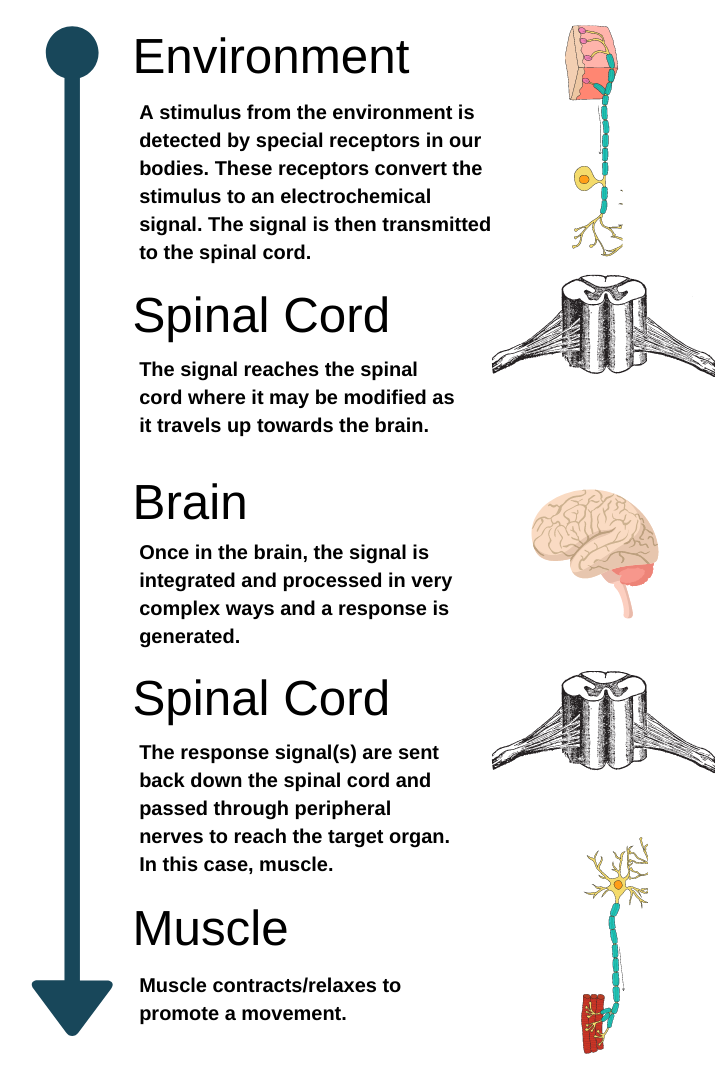
Information about our internal and external environments is detected by special receptors in our skin, muscles, internal organs, eyes, ears, nose, and mouth. These receptors translate the information into electrochemical signals which are transmitted to the brain via the spinal cord.
Once in the brain, these signals are processed and integrated in very complex ways. After processing and integrating these signals, a response is generated. The responses are considered the output of our computer analogy. Responses may represent our movements, our behaviors, and our mood states.
Obviously, this is a very simplified view of the nervous system.
The basic pathway for producing an appropriate motor response to an environmental stimulus is diagrammed below.